Ankle Weights for Walking vs Strength Work: Only One Is Worth It
Quick Answer: Ankle weights work well for slow, controlled strength exercises - side-lying leg lifts, standing abductions, glute work - where the load is applied through a deliberate range of motion. They work poorly for walking, where they alter your natural gait, load the knee and hip in a repeated pattern your body didn’t choose, and add relatively little metabolic cost for the risk. Use them for reps, not for miles.
The appeal of walking with ankle weights is obvious: same walk, more work. The problem is that the extra work lands somewhere you didn’t intend.

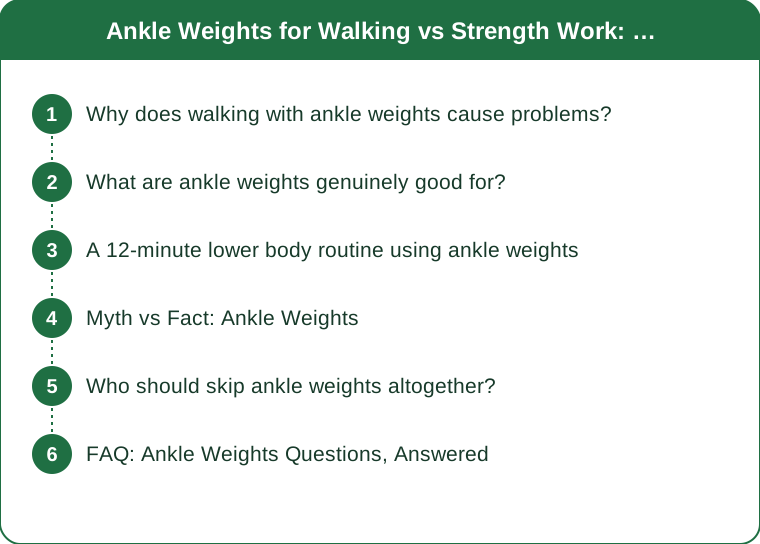
Why does walking with ankle weights cause problems?
Because the weight sits at the far end of a swinging lever, and your gait adapts to it whether you want it to or not.
During walking, your leg swings forward as a pendulum with most of the movement driven by momentum rather than muscle. Add mass at the ankle - the furthest point from the hip - and you dramatically increase the rotational load of that swing.
What actually changes:
- Stride mechanics alter. Most people shorten their stride and change their foot strike to manage the added swing weight, which is a gait change repeated thousands of times per walk
- Hip flexors work substantially harder in a pattern they weren’t loaded for, which is where the aching front-of-hip complaint after weighted walking comes from
- Knee joint loading increases during the swing and at heel strike, particularly with heavier weights
- Ankle and shin muscles work overtime to control the foot, which is why shin pain is a common outcome
The energy cost is real but modest, generally in the range of a small percentage increase for typical ankle weights - a fraction of what you’d get from simply walking faster or finding a hill.
The honest summary: walking faster, adding gradient, or carrying weight closer to your centre of mass gives you more benefit with less joint cost. If you want a harder walk, those three come first.
What are ankle weights genuinely good for?
Slow, controlled, single-joint strength movements - which is what they were designed for.
In a deliberate exercise, you control the speed, the range, and the position. There’s no repeated impact, no swing momentum, and no gait to disrupt. The weight simply adds resistance to a movement you were already doing correctly.
The movements where they earn their place:
- Side-lying hip abduction - hard to load any other way at home, and one of the best hip strengthening options
- Standing hip abduction and extension - glute medius and glute max work with a clear line of resistance
- Prone hamstring curls - a genuinely useful home substitute for a machine
- Fire hydrants and donkey kicks - the classic use case, and a legitimate one
- Seated leg extensions - useful for quad strengthening, often used in rehab settings under guidance
- Dead bug and reverse crunch variations - added load for core work
Weight guidance: 0.5-1kg per ankle is enough for most of these to start, and 1.5-2.5kg is a reasonable ceiling for home use. If you can do 20 clean reps easily, add weight or slow the tempo rather than adding more reps.
Form comes first, always. The point of ankle weights in these movements is that the target muscle works harder, not that the movement gets bigger.
A 12-minute lower body routine using ankle weights
Twice a week, on non-consecutive days. All movements slow - three seconds up, three seconds down.
1. Side-lying hip abduction - 3 x 12 per side. Lie on your side, stack your hips, lift the top leg without rolling backward. If your hip flexor at the front is burning, you’re rolling.
2. Standing hip extension - 3 x 12 per side. Hold a chair, keep the torso still, drive the leg straight back from the glute. Range is small - about 15 degrees. If your low back is arching, the range is too big.
3. Prone hamstring curl - 3 x 10 per side. Lie face down, curl the heel toward your glute slowly, and lower with control. Lowering is where the value is.
4. Fire hydrant - 2 x 12 per side. On all fours, lift the knee out to the side without shifting your torso.
5. Reverse crunch - 2 x 10. On your back, knees bent, lift the hips off the floor using the abdominals rather than swinging.
Progression: when all sets are comfortable at the current weight, add tempo first (four seconds down), then add weight. Adding reps past about 15-20 stops building strength and starts building endurance, which is a different goal.
Stop any movement that produces sharp joint pain rather than muscular effort. This is general information, not medical advice.

Myth vs Fact: Ankle Weights
Myth: Ankle weights on a walk burn significantly more calories. Fact: The increase is modest - typically a small single-digit percentage for common weights. Walking 15% faster or adding a hill does considerably more, with no gait disruption.
Myth: They’ll tone your legs faster. Fact: They add resistance, which is useful in controlled exercises. “Toning” is muscle plus lower body fat, and neither responds to ankle weights specifically.
Myth: Heavier is better. Fact: Beyond the point where your form or tempo degrades, added weight makes the exercise worse rather than harder. Most home users are better served by 1kg and strict tempo than 3kg and momentum.
Myth: They’re a rehab tool, so they’re always safe. Fact: They’re used in rehab in specific prescribed movements at specific loads. That’s very different from wearing them for an hour around the house, which is where a lot of the reported hip and knee complaints originate.
Myth: Wearing them all day builds endurance. Fact: It builds a chronically altered gait and loads your joints in a pattern you’re not monitoring. This is the most common misuse and the one worth avoiding entirely.
Who should skip ankle weights altogether?
Several groups, and it’s worth checking before you buy.
Anyone with current knee, hip, or ankle pain. Added distal load on an already irritated joint is not a rehabilitation strategy unless a clinician has prescribed it specifically.
Anyone with balance concerns or a fall history. Ankle weights alter the swing phase of gait and change how quickly you can reposition a foot - a meaningful risk factor when balance is already a concern.
Anyone in the postpartum period who hasn’t rebuilt core and pelvic floor support. Loaded leg movements increase demand on a system that’s still recovering.
Runners, for running. This one is unambiguous: the impact forces are already high, and adding distal mass increases loading rate and alters mechanics at exactly the wrong moment.
Anyone using them to compensate for not doing strength work. They’re a supplement to loaded exercise, not a replacement. A pair of dumbbells and bodyweight squats will do more for lower body strength than any ankle weight routine.
If you’re recovering from injury, have arthritis, or are unsure, ask a physiotherapist which movements and what load suit you. It’s a short conversation and it prevents the most common problem.
FAQ: Ankle Weights Questions, Answered
Can I use them for the elliptical or the stairclimber?
Better than walking, because the foot path is guided and impact is low, but the same swing-load principle applies to some degree. Adding machine resistance is a cleaner way to make it harder.
How heavy should my first pair be?
0.5-1kg per ankle for most people. Adjustable pairs that let you add sand or metal bars are worth the small extra cost, because you’ll outgrow the starting weight in a few weeks.
Are wrist weights the same problem?
Similar physics, lower stakes, because the arms carry less bodyweight load. The same rule applies: excellent for controlled exercises, poor for wearing on a walk or a run.
How long until I notice a difference?
With twice-weekly controlled work, most people notice strength and control changes at four to six weeks. Visible change is a matter of overall training and body composition, not the weights themselves.
TL;DR:
- Use ankle weights for slow controlled strength movements, not for walking
- Walking with them alters gait, loads the knee and hip flexors, and adds little energy cost
- 0.5-1kg to start; progress tempo before weight
- The best home uses are side-lying abduction, standing extension, prone curls, and fire hydrants
- Skip them entirely if you have joint pain, balance concerns, or you’re running
Ankle weights aren’t a bad tool. They’re a specific tool being used for the one job they’re worst at.
Keep Reading
This article is for general informational and styling purposes only. Fit, sizing, and product availability may vary.