Do Ankle Weights Actually Make Walking Better? What the Evidence Says
Quick Answer: Ankle weights do increase the energy cost of walking - research on added distal limb load suggests roughly a 5 to 10 percent rise in oxygen cost per pound added at the ankle, which is far more efficient per pound than carrying the same weight at the torso. But they also alter gait mechanics and increase load on the knee and hip through the swing phase. For general fitness, walking faster or on a hill achieves more with less risk. For specific rehab or strength goals under guidance, they have a place.
The short version: they work, and they are also usually not the tool you want. Here is the actual trade-off.

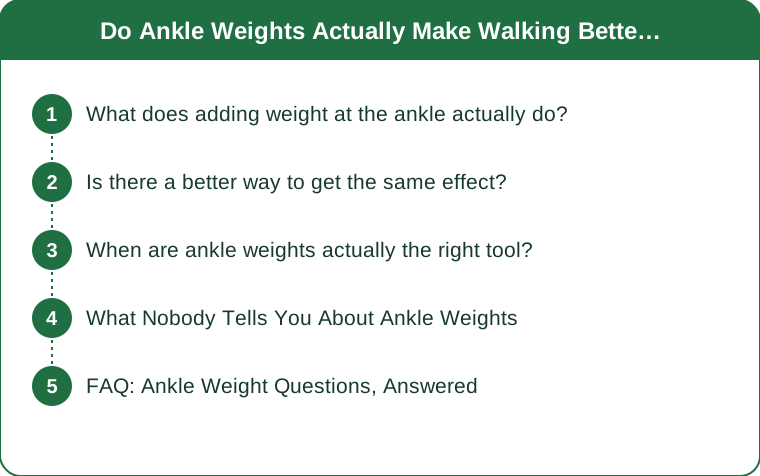
What does adding weight at the ankle actually do?
Distal load is disproportionately expensive. Weight carried far from the body’s center of mass costs much more energy to move than weight carried at the torso, because it has to be accelerated and decelerated through a much larger arc every stride. This is well established in load carriage research and it is why a pound at the ankle is not the same as a pound in a backpack.
The reported effect size is meaningful. Studies on added ankle mass have found oxygen cost increases in the region of 5 to 10 percent per pound per ankle during walking, with variation by walking speed and individual gait. Two-pound weights on each ankle can therefore represent a real increase in metabolic demand.
But your gait changes to accommodate it. People typically shorten stride slightly, alter cadence, and change hip and knee flexion patterns when ankle-loaded. Those changes are the body reducing the cost, and they are also the source of the concern.
Load at the knee rises during swing. The added mass creates a longer lever acting on the knee as the leg swings forward, increasing forces at the joint. For a healthy joint under modest load this is usually tolerable; for a knee with existing pain or arthritis it is a poor idea without guidance.
And the hip flexors take the additional work. Hip flexor soreness after a first walk with ankle weights is extremely common and is a direct signal of where the load went.
Is there a better way to get the same effect?
Walking faster is the cleanest option. Increasing pace raises energy cost substantially with no change to load distribution and no additional joint torque from external mass. Going from a 20-minute mile to a 15-minute mile is a large metabolic change that costs nothing and risks nothing.
Hills or an incline treadmill are the next best. A 5 percent incline raises energy cost markedly and loads the posterior chain in a way flat walking does not. It also has no effect on swing-phase mechanics, which is the main concern with ankle weights.
A weighted vest is better if you specifically want added mass. It sits near the center of mass, does not change limb mechanics, and loads the whole system including bone - which is relevant if bone density is one of your goals. The trade is that it is less metabolically expensive per pound, so you need more of it.
Rucking - a loaded backpack - is the same principle and more accessible. Ten to fifteen pounds in a backpack on a normal walk achieves a real training effect with essentially no mechanical downside.
And plain intervals work on a walk. Two minutes brisk, two minutes easy, repeated. This raises average intensity more than two-pound ankle weights do, and it needs no equipment at all.

When are ankle weights actually the right tool?
Targeted strength work, not walking. Ankle weights are genuinely useful for standing hip abduction, leg raises, clamshells, donkey kicks, and similar isolation exercises where the resistance is the point and the movement is controlled. This is what they were designed for.
Prescribed rehabilitation. Physiotherapists use them regularly for quadriceps and hip strengthening at loads and in positions chosen deliberately. Following a program is a different situation from strapping them on for a walk.
Progressive loading in seated or lying positions. Terminal knee extensions, straight leg raises, and hamstring curls all benefit, and none of them involve gait.
Occasionally, gait retraining under supervision. There are specific clinical applications, but they are supervised for a reason.
What they are not good for: general cardio, all-day wear, running, or stair climbing. Running with ankle weights substantially increases impact forces and alters mechanics at speed, and no reputable guidance supports it.
And weight matters. If you do use them for walking, one to two pounds per ankle is the sensible ceiling for most people, added gradually, on flat ground, and not every session. Anything heavier is being used in a way the risk profile does not support.
What Nobody Tells You About Ankle Weights
Hip flexor soreness the next day is the norm, not a sign of a good workout. It reflects the specific muscle group that absorbed the additional demand, and it is often disproportionate to the actual training benefit received.
The gait changes persist briefly after removal. Some people report feeling odd for a few minutes after taking them off, which reflects how quickly the motor system adapts to the altered mass. It is harmless and it is also a reminder that gait was genuinely altered.
They are far more effective for strength work than the marketing suggests. The category is sold for walking and is genuinely good at hip abduction work, which is nearly the reverse of how it is advertised. A pair used twice a week for lying and standing isolation exercises earns its cost easily.
Straps loosen and shifting weights are worse than fixed ones. A weight that slides down toward the foot changes the lever arm mid-walk and creates an inconsistent load. Check the fit at the start and again after five minutes.
Numbness or tingling in the foot means stop immediately. A strap tight enough to restrict circulation or compress a superficial nerve is a real risk with ankle weights and is easy to miss until it has been going on for twenty minutes.
And the honest bottom line: the same effort spent walking ten minutes longer or noticeably faster produces more benefit with less risk. That is not an argument that ankle weights do nothing - it is an argument about opportunity cost, and it is the part the marketing never covers.
If you have knee, hip, or ankle pain, arthritis, or any balance concerns, talk to a physiotherapist or doctor before adding ankle load. This is general information, not medical advice.
FAQ: Ankle Weight Questions, Answered
Do ankle weights actually burn more calories?
Yes - added mass at the ankle raises oxygen cost during walking by roughly 5 to 10 percent per pound, which is considerably more per pound than the same weight carried at the torso. Whether that is worth the altered gait mechanics is the real question.
Are ankle weights bad for your knees?
They increase load on the knee during the swing phase because the added mass acts on a long lever. For a healthy joint with light weights this is usually tolerable; with existing knee pain, arthritis, or a history of injury, get guidance first.
How heavy should ankle weights be?
One to two pounds per ankle is the sensible ceiling for walking, introduced gradually and on flat ground. For targeted strength exercises like hip abduction, heavier can be appropriate because the movement is controlled and the volume is low.
Can I run with ankle weights?
No, that is not advisable. Running already generates impact forces of several times body weight, and adding distal mass increases those forces and alters mechanics at speed. If you want more running stimulus, run faster or add a hill.
TL;DR:
- Ankle weights genuinely raise walking energy cost, roughly 5 to 10 percent per pound, because distal mass is expensive to move.
- They also alter gait and increase knee load through the swing phase, which is the real trade-off.
- Walking faster, adding an incline, or wearing a weighted vest achieves more with less mechanical risk.
- Their best actual use is targeted strength work - hip abduction, leg raises, clamshells - not walking.
- Cap at one to two pounds per ankle for walking, never run in them, and stop immediately with numbness or tingling.
Useful tool, commonly used for the wrong job. Save them for the floor work.
Keep Reading
This article is for general informational and styling purposes only. Fit, sizing, and product availability may vary.