The Strangest Thing About Ankle Weights Happens After You Take Them Off
Quick Answer: After wearing ankle weights, your nervous system keeps producing the muscle output it needed for the heavier limb, so the first minutes of unweighted walking feel light and slightly exaggerated - the legs lift higher than intended. It is a short-lived motor aftereffect, and it usually settles within a few minutes. It matters practically because that window is when your foot clearance and step timing are least accurate, which is a poor moment for stairs, uneven ground, or a run. Walk on flat, familiar ground for a few minutes before doing anything demanding.
You finish the routine, unstrap them, and take a few steps that feel like walking on the moon. Everybody notices this. Almost nobody is told what it is or why it briefly matters.

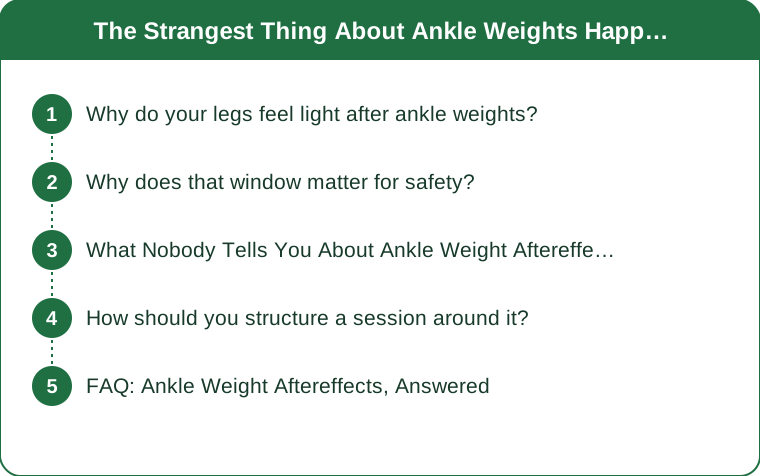
Why do your legs feel light after ankle weights?
Your nervous system has been calibrating to a heavier limb. Motor control works on internal models - the brain predicts how much output a movement needs and issues the command before feedback arrives. Add mass at the ankle and the model updates over minutes to account for it. Remove the mass and the model lags, so the same command now produces a bigger movement than intended.
The effect is most visible at the end of the swing phase. Ankle weights add mass at the far end of a lever, which disproportionately affects the swing of the leg rather than the push-off. So the exaggeration shows up as the foot lifting higher and swinging further than you meant, which is exactly the sensation people describe as floaty.
It is a well-known category of motor aftereffect. The same principle underlies the classic experience of pushing your arms outward against a doorframe and then feeling them rise on their own afterward. It is a normal, temporary recalibration, not a sign of anything wrong.
Duration is usually short. Most people report it settling within a few minutes of normal walking, though heavier weights and longer wear tend to extend it. The recalibration happens through movement, which is why walking it off works better than sitting down.
And it says nothing about training effect. The floaty feeling is often interpreted as evidence that the weights did something powerful. It is evidence that your motor system adapted to a load, which is a different and much less interesting claim than the training benefit people hope it indicates.
Why does that window matter for safety?
Foot clearance accuracy is temporarily degraded. Tripping happens when the foot’s actual clearance does not match the predicted clearance. During the aftereffect, your prediction is off - usually in the direction of lifting too high, but the timing of foot placement is also less precise, and that is the component that matters for stairs.
Stairs are the worst place to be during it. Descending stairs requires accurate placement of a foot you cannot fully see, on a surface with no margin for error. Doing that in the first minutes after removing ankle weights is an avoidable risk, particularly for anyone with balance concerns.
Uneven ground is the second worst. Trails, curbs, and grass all require rapid clearance adjustments, and those adjustments are calibrated by the same model that is temporarily miscalibrated.
Running immediately afterward is a common mistake. People do a weighted walking or mobility segment and then head straight into a run. Running with a miscalibrated swing pattern for the first minutes is not catastrophic, but it does mean starting a run with an unusual gait, which is not how you want to start any run.
The straightforward mitigation is boring and effective. Two to five minutes of normal walking on flat, familiar ground after removing them, before stairs, running, or anything technical. That is the whole safety intervention, and it is why this is worth knowing about.

What Nobody Tells You About Ankle Weight Aftereffects
Nobody tells you the effect is a decent proxy for whether the weights were too heavy. A mild, brief lightness is normal. A pronounced effect that takes ten minutes to settle usually means the load was high enough to substantially alter your gait during the session - which is precisely the scenario associated with hip flexor strain and altered mechanics.
Nobody tells you that gait alteration during the session is the actual concern. The aftereffect is temporary and mostly harmless. The thing worth watching is whether your walking pattern changed while wearing them - a shortened stride, a swinging-out leg, or increased hip hitching means the load exceeded what your normal pattern could absorb.
Nobody tells you it fades with training. As you adapt to a given weight, both the in-session gait change and the aftereffect diminish. That is a reasonable signal that the load has become manageable - and, for people using them progressively, a signal about when a small increase might be appropriate.
Nobody tells you that footwear amplifies it. Doing weighted work in one shoe and then walking in bare feet or different shoes stacks two calibration changes at once. Keep footwear constant across the transition.
And nobody tells you the effect is stronger for movements you did repetitively. Fifty repetitions of a standing leg lift produces a much clearer aftereffect in that specific pattern than a varied session does, because the model updated more strongly in one direction.
How should you structure a session around it?
Finish with the weights off, not on. End the session with a few minutes of unweighted movement - normal walking, some gentle mobility - so the recalibration happens under your supervision rather than on your stairs.
Remove them sitting down, then stand and walk on flat ground. Standing up and immediately walking off is where the surprise happens.
Do not stack them onto a workout that needs precision. Weighted leg work then balance training is a poor order. Balance training first, weighted work second, then unweighted walking is a better sequence.
Use them for defined sets, not all-day wear. Wearing ankle weights during general daily activity keeps the altered gait running for hours and gives your body a long time to adopt compensations. Defined sets with a clear end is the standard recommendation for a reason.
Keep the load conservative. Common guidance for general fitness use is to start light - often in the range of one to three pounds per ankle - and increase only when the movement pattern stays clean throughout. If your gait changes visibly while wearing them, the weight is too heavy regardless of how easy it feels.
And stop and reassess if anything is sharp, numb, or persistent. Ankle weights are associated with hip flexor, knee, and shin complaints when used too heavily or too often, and numbness or tingling is a pressure signal that means loosen or remove immediately. This is general information, not medical advice - anyone rehabbing an injury should follow their clinician’s guidance rather than a general article.
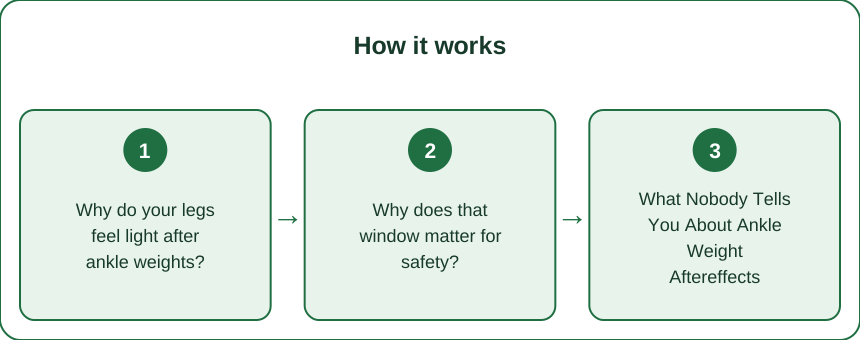
FAQ: Ankle Weight Aftereffects, Answered
Why do my legs feel floaty after taking off ankle weights?
Your nervous system calibrated its output to the added mass, and removing it leaves the prediction temporarily too strong, so the leg swings higher than intended. It is a normal motor aftereffect that typically settles within a few minutes of ordinary walking.
Is that feeling dangerous?
Not inherently, but foot clearance and placement are temporarily less accurate, which makes the first few minutes a poor time for stairs, uneven ground, or running. Walk on flat, familiar ground for a few minutes before anything technical.
Does the effect mean the weights are working?
No - it indicates your motor system adapted to a load, which is not the same thing as a training benefit. A pronounced, long-lasting aftereffect is more useful as a sign the weight was heavy enough to change your gait, which is generally a reason to go lighter.
Should I wear ankle weights all day?
Generally not. Defined sets with a clear endpoint are the standard approach, because all-day wear keeps an altered gait running for hours and gives compensations time to establish. Keep loads conservative and stop if anything is sharp or numb.
TL;DR:
- The floaty feeling after removing ankle weights is a normal motor aftereffect - your nervous system is still producing output calibrated to a heavier limb.
- It matters because foot clearance and placement are temporarily less accurate, making stairs, uneven ground, and running poor immediate choices.
- Walk on flat, familiar ground for two to five minutes afterward; that is the entire mitigation.
- A strong, long-lasting aftereffect is a signal the load was heavy enough to alter your gait during the session - usually a reason to go lighter.
- Use defined sets rather than all-day wear, keep footwear constant, and stop for anything sharp, numb, or persistent.
The weird moon-walking minute is not a sign the workout was powerful. It is your motor system recalibrating - and knowing that is what keeps it from happening on a staircase. This is general information, not medical advice.
Keep Reading
This article is for general informational and styling purposes only. Fit, sizing, and product availability may vary.