How Heavy Should Your Ankle Weights Actually Be?
Quick Answer: Most beginners should start at 1-2 lbs per ankle for walking and light strength work, moving up to 3-5 lbs only once form stays clean through a full set. Anything heavier changes your gait mechanics and raises joint strain risk faster than it builds strength.
More weight feels like more results, so it’s tempting to grab the heaviest pair on the shelf. Ankle weights are one of the few tools where going heavy too fast actively works against you instead of just being slower progress.

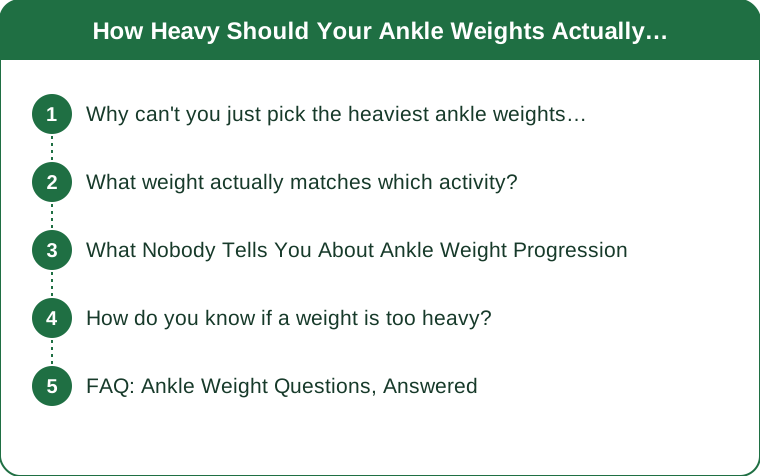
Why can’t you just pick the heaviest ankle weights available?
Ankle weights load a joint (the ankle) that wasn’t designed to carry significant extra weight through repetitive movement. Once the weight exceeds what your hip and knee can control cleanly, your body compensates by altering gait or swing pattern — which is exactly how strain injuries start.
As a rough guideline, anything past 5 lbs per ankle for walking starts meaningfully increasing joint stress in most users, according to physical therapy guidance on load-bearing extremity training.
What weight actually matches which activity?
Walking: 1-2 lbs per ankle is plenty — more just changes your natural gait. Leg lifts and glute work: 2-3 lbs is a solid working range for most beginners, moving to 3-5 lbs as strength builds. Pilates or barre-style work: stay at 1-2 lbs, since the exercises rely on precise small movements that heavier weight disrupts rather than intensifies.

What Nobody Tells You About Ankle Weight Progression
Here’s the part that surprises people: ankle weights don’t need to progress the way dumbbells do. Because the joint and movement pattern are more injury-sensitive, a lot of the actual strength gain comes from rep count and control, not steadily climbing weight.
Staying at 2-3 lbs and increasing reps or adding pulses often builds more usable strength, with less risk, than chasing a heavier pair every few weeks.
How do you know if a weight is too heavy?
The clearest sign: your movement speed changes, or you feel the weight swinging rather than being controlled through the full range of motion. If your walking pace slows noticeably or your leg lift starts using momentum instead of muscle, that’s the weight talking — drop down one size.
Mild ankle or shin discomfort after a session is also a signal to reduce weight before your next session, not push through.
FAQ: Ankle Weight Questions, Answered
Can ankle weights be used every day?
For light walking use (1-2 lbs), most people tolerate daily use fine. For strength-focused sets, 3-4 sessions a week with rest days between is a safer default.
Are adjustable ankle weights worth the extra cost over fixed ones?
Yes, for most people — being able to add or remove small increments lets you match weight to the specific exercise instead of owning multiple fixed pairs.
Do ankle weights help with weight loss directly?
They modestly increase calorie burn during use, but the bigger benefit is added resistance for muscle activation — pair with your overall activity level rather than expecting weight loss from the weights alone.
TL;DR:
- Start at 1-2 lbs for walking, 2-3 lbs for leg lifts and glute work
- Past roughly 5 lbs per ankle, gait and joint stress risk rises faster than strength benefit
- Progress through reps and control first — ankle weights don’t need to climb like dumbbells
- Slowed movement speed or swinging weight is your sign to size down
Check your current pair against these ranges before your next walk or set.
Keep Reading
This article is for general informational and styling purposes only. Fit, sizing, and product availability may vary.