Should You Wear Ankle Weights on Stairs? The Honest Answer
Quick Answer: Ankle weights on stairs add load exactly where fall risk is highest and where the hip flexors are already working hardest, which is why most trainers advise against them for regular stair climbing. They can make sense for slow, controlled, hand-on-rail step-ups on a single step - but not for climbing multiple flights at normal pace.
Stairs already make your legs work, so adding ankle weights seems like free extra training. The mechanics say otherwise, and the reason is specific enough to be worth understanding rather than just following a blanket rule.

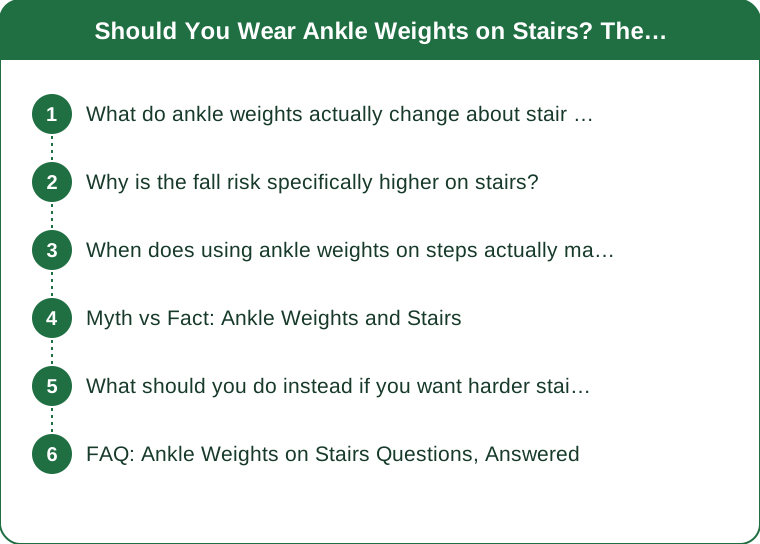
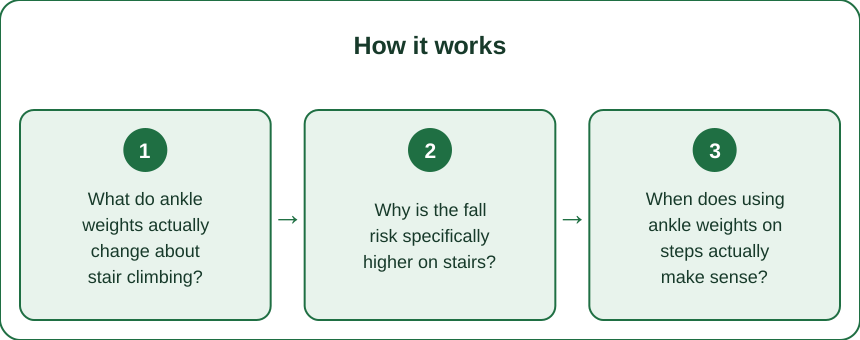
What do ankle weights actually change about stair climbing?
Two things, and they’re different from what most people expect.
They add load at the end of a long lever. Weight at the ankle sits far from the hip joint, which multiplies the torque your hip flexors have to produce to swing the leg forward. A 1kg ankle weight does not feel like 1kg to your hip flexor - it feels like considerably more, because of that lever length.
On stairs, hip flexion is already the demanding part. You’re lifting your whole leg to a higher position with every single step, far more than you do walking on flat ground. Ankle weights load exactly the muscle group that’s already the limiting factor.
They change your swing timing. Extra mass at the foot alters how quickly your leg swings through, and the change is enough that your foot placement timing shifts slightly. On flat ground that’s inconsequential. On stairs, foot placement precision is what keeps you from catching a toe on the step edge.
Why is the fall risk specifically higher on stairs?
Stair falls are among the more serious household fall categories, and the mechanism is usually the same: the toe catches the nose of the step on the way up, or the foot lands short on the way down.
Ankle weights work against you in both directions.
Going up: the added mass increases how much foot clearance costs you in effort. As your hip flexors fatigue - which happens faster with weights - clearance drops, and a toe that clears by 3cm on step one might clear by 1cm on step forty.
Going down: this is worse. Descending stairs is an eccentric, controlled-lowering movement, and added ankle mass increases the momentum your quadriceps have to control on each landing. Fatigued quads on a descent are a well-recognised fall scenario.
Reaction time also matters. If you do stumble, catching yourself requires quickly repositioning a leg - and that’s exactly the movement ankle weights slow down.
The risk isn’t theoretical or evenly distributed: it’s concentrated in the moment you’re already most vulnerable.
When does using ankle weights on steps actually make sense?
There’s a version that works, and it’s much more controlled than ‘wear them while climbing the stairs.’
Slow, deliberate step-ups on a single step, with a handrail available.
- One step only, not a flight
- Deliberate pace - roughly 2 seconds up, 2 seconds down
- Hand near or on the rail
- Fixed rep count (8-10 per leg), so you stop before fatigue rather than after
- Light weight - 0.5-1kg to start, and honestly assess whether more is needed
This version keeps the training stimulus while removing what makes stairs risky: repetition under fatigue, speed, and no available support.
It also makes sense for: controlled rehabilitation work prescribed by a physiotherapist, who has assessed your specific situation and can adjust load appropriately.
It does not make sense for: wearing them around the house ‘to get extra work in,’ climbing multiple flights, descending stairs at all, or any situation where you’re carrying something in your hands.

Myth vs Fact: Ankle Weights and Stairs
Myth: If you can climb stairs normally, you can climb them with weights. Fact: The failure point isn’t strength at step one - it’s clearance at step thirty, when hip flexors have fatigued in a way they don’t without added load.
Myth: Light weights are automatically safe. Fact: The lever effect means even 0.5kg meaningfully changes hip flexor demand and swing timing. Lighter is safer, not safe.
Myth: Going down is easier so it’s lower risk. Fact: Descent is the higher-risk direction for stair falls generally, and added ankle mass increases the eccentric load your quads must control on each landing.
Myth: This is only a concern for older adults. Fact: The mechanics apply at any age. Consequences of a fall differ by age, but toe clearance and swing timing don’t care how old you are.
Myth: Ankle weights are the only way to make stairs harder. Fact: Carrying a weighted backpack loads the same climb without changing swing mechanics or toe clearance at all - it’s the better tool for this specific job.
What should you do instead if you want harder stairs?
A weighted backpack or vest. This is the direct substitute and it’s better in every relevant way: the load sits close to your centre of mass, it doesn’t alter leg swing timing, it doesn’t reduce toe clearance, and it’s easy to remove. Start with 5% of body weight.
Increase pace instead of load. Climbing the same flight faster is a genuine progression and it trains power, which matters more than added mass for most functional goals.
Add flights. Volume is the simplest progression available and requires no equipment at all.
Single-step step-ups without weights, but slower. Three seconds up, three seconds down on a single step is harder than it sounds and eliminates the fall-risk profile entirely.
If you specifically want hip flexor training, do it seated or lying - seated leg lifts with an ankle weight, or lying leg raises. This gets the training effect of loaded hip flexion in a position where a mistimed swing can’t put you on the floor.
Stop and reassess if you notice: shin pain, hip flexor soreness lasting more than 48 hours, knee discomfort, or any catch or stumble on a step. This is general information, not medical advice - persistent joint pain deserves a professional look.
FAQ: Ankle Weights on Stairs Questions, Answered
Is it okay to wear ankle weights while doing housework that involves stairs?
This is the most common real-world version of the question, and it’s the one worth avoiding - it combines weights, stairs, carrying items, and distraction all at once.
What weight is safe for step-up exercises?
0.5-1kg is a reasonable starting range for controlled single-step work with a rail available. Progress by adding reps before adding weight.
Does this apply to weighted vests on stairs too?
Much less. A vest keeps load near your centre of mass and doesn’t affect leg swing or toe clearance, which is why it’s the better option for loaded stair work.
I’ve been doing this for months with no problems - should I stop?
Risk isn’t the same as certainty, and no incident so far isn’t proof of safety. If you want to continue, at minimum keep a hand on the rail and stop while fresh rather than climbing to fatigue.
TL;DR:
- Ankle weights load hip flexors through a long lever, which is exactly what limits stair climbing
- Reduced toe clearance under fatigue is the specific mechanism behind stair falls
- Descending is the higher-risk direction and the worst place for added ankle mass
- Controlled single-step step-ups with a rail are the version that works
- A weighted backpack achieves the same goal without changing leg swing mechanics
Stairs are already good training. Load them somewhere other than your ankles. This is general information, not medical advice.
Keep Reading
This article is for general informational and styling purposes only. Fit, sizing, and product availability may vary.