Why Ankle Weights Always Feel Heavier on One Side — and What to Do About It
Quick Answer: Feeling one ankle weight as heavier is usually due to natural strength or stability asymmetry between legs, not a manufacturing difference — most people have a dominant leg that’s measurably stronger, making an identical weight feel different on each side.
You check the label, both weights say the same number, but one ankle clearly feels like it’s working harder through the whole set. Before assuming a defective pair, it’s worth knowing this asymmetry is extremely common and has a specific, fixable cause.

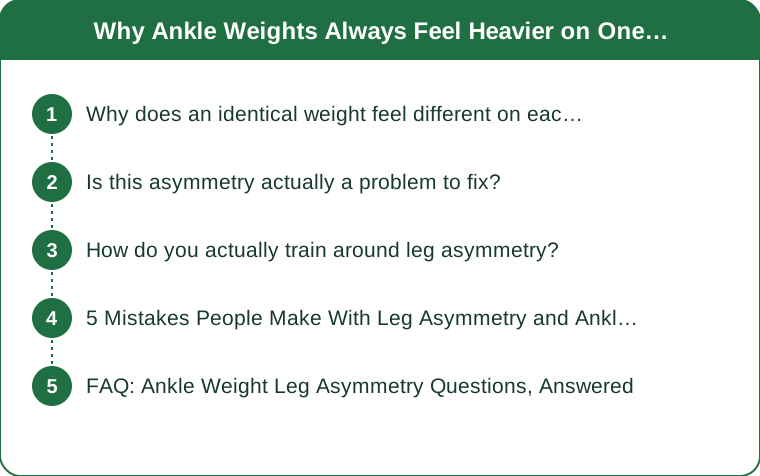
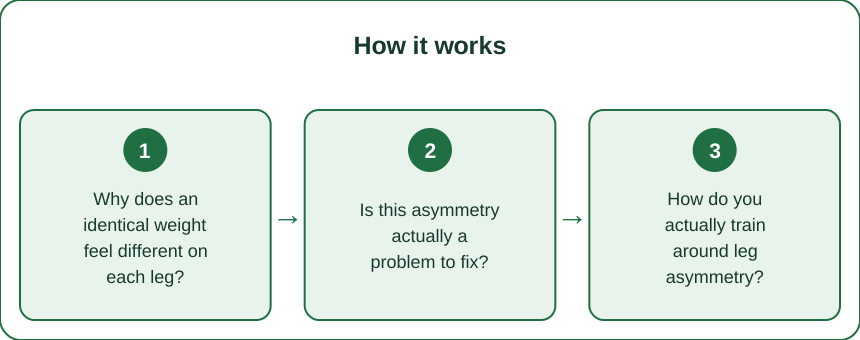
Why does an identical weight feel different on each leg?
Because most people have measurable strength and stability differences between their dominant and non-dominant leg — often in the 5-15% range — which is enough to make an identical external weight feel meaningfully different.
This isn’t unique to ankle weights; it shows up in single-leg exercises generally, ankle weights just make it more noticeable since you’re isolating each leg’s effort.
Is this asymmetry actually a problem to fix?
A mild, consistent difference is normal and not inherently concerning. It becomes worth addressing if the gap is large enough to cause compensatory form changes — like hip hiking or knee wobble on the weaker side — which can increase injury risk over time.
Watch your form in a mirror or on video during single-leg ankle-weight work; if the weaker side visibly compensates, that’s the signal to scale back reps on that side rather than push through matching sets.

How do you actually train around leg asymmetry?
Train the weaker leg first, while it’s freshest, and consider slightly higher volume (1-2 extra reps) on that side rather than forcing identical sets on a leg that’s working harder for the same output.
Over several weeks, the gap in perceived effort should narrow — if it doesn’t, or gets worse, that’s worth mentioning to a trainer or physical therapist rather than continuing to push through.
5 Mistakes People Make With Leg Asymmetry and Ankle Weights
1. Ignoring it and pushing identical volume on both sides regardless of visible compensation.
2. Assuming it means the weights are defective and returning perfectly good equipment.
3. Overcorrecting with much heavier weight on the weaker side, which can worsen form breakdown instead of fixing it.
4. Not checking form in a mirror, missing the compensation patterns that actually matter.
5. Stopping ankle weight work entirely instead of just adjusting volume per side.
FAQ: Ankle Weight Leg Asymmetry Questions, Answered
Is a 10-15% strength difference between legs normal?
Yes, this range is common in the general population and isn’t automatically a sign of dysfunction — it becomes more relevant if it’s worsening or causing visible compensation.
Should I use different weights on each ankle to compensate?
Generally not recommended — adjusting reps or sets per side is a more controlled way to address the imbalance than using mismatched external loads.
When should leg asymmetry be checked by a professional?
If the difference feels like it’s increasing, causes pain on one side specifically, or shows up as significant visible compensation, a physical therapist can assess it more precisely than self-monitoring alone.
TL;DR:
- Feeling one ankle weight as heavier reflects normal strength asymmetry, not defective equipment
- Mild asymmetry is common; visible compensation in form is the actual signal to address
- Train the weaker leg first, with slightly higher volume rather than matching heavier weight
- Persistent or worsening asymmetry is worth a professional check, not just self-correction
One heavier-feeling ankle isn’t a flaw in your gear — it’s useful information about how your body actually works.
Keep Reading
This article is for general informational and styling purposes only. Fit, sizing, and product availability may vary.