Ankle Weights vs Wrist Weights: Why You Can't Just Use Either One Interchangeably
Quick Answer: Ankle weights add resistance to leg movements like leg raises and kicks; wrist weights add resistance to arm movements like punches and arm circles. Using one for the other’s job either does nothing useful or adds strain to a joint that wasn’t designed to carry it.
They look like the same product in a different size — a padded cuff with a strap. But the joints they attach to handle load completely differently, and that difference matters more than it looks.

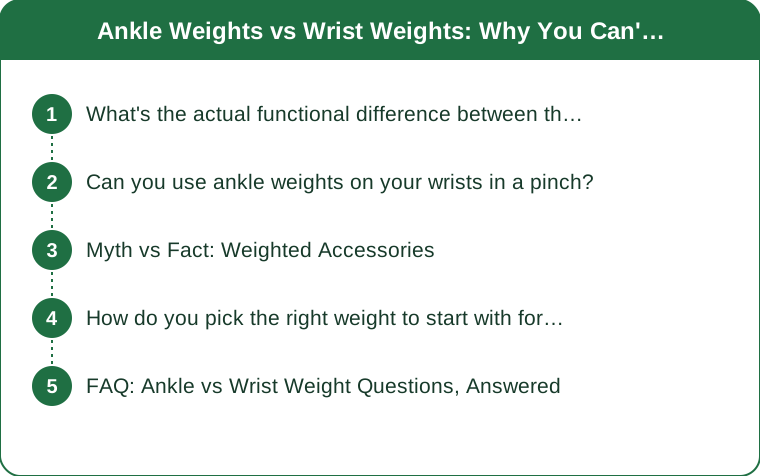
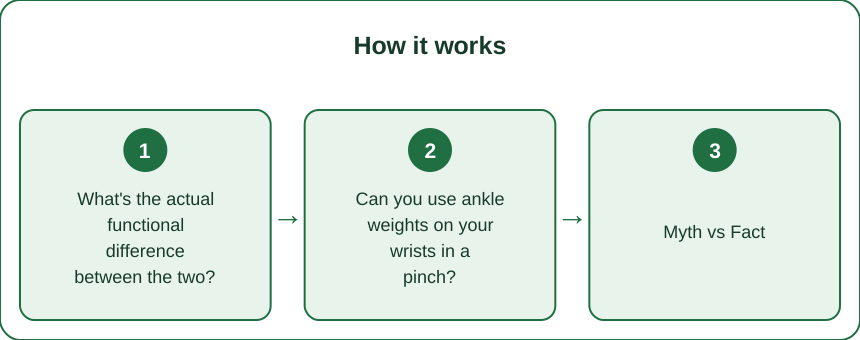
What’s the actual functional difference between the two?
It comes down to joint size and range of motion. Ankles are a hinge joint carrying your full body weight during daily movement, so they tolerate load differently than wrists, which are smaller, more mobile, and not built for sustained weight-bearing.
Ankle weights are designed for larger muscle groups (hips, glutes, hamstrings) moving through leg-based exercises. Wrist weights target smaller stabilizer muscles in shoulders and arms during upper-body movement — different muscle groups, different intended load.
Can you use ankle weights on your wrists in a pinch?
Not safely, no. Ankle weights are typically heavier (1-5+ lbs standard) than wrist weights (0.5-2 lbs standard) because ankles handle more mass in daily function. Strapping ankle-weight-level resistance onto a wrist during arm circles or punches puts excessive strain on the smaller wrist joint and surrounding tendons — this is a common cause of wrist strain, not a harmless substitution.
If you only own one type, use it for its intended limb, or skip the exercise rather than cross-purpose it.

Myth vs Fact: Weighted Accessories
Myth: Heavier is always better for faster results. Fact: Both types are meant to be light, controlled resistance — going too heavy changes your form and shifts strain to the joint instead of the target muscle.
Myth: Wearing them all day burns extra calories passively. Fact: The calorie difference from all-day wear is minimal and the joint strain from prolonged wear is a real downside — save them for active exercise sets only.
Myth: They’re interchangeable if the weight number matches. Fact: Even at the same weight, cuff shape and strap design differ for ankle vs wrist fit and movement pattern.
How do you pick the right weight to start with for each?
For wrists: start at 0.5-1 lb — this is enough to add resistance to arm circles and punches without straining the joint. For ankles: start at 1-2 lbs for leg raises and kicks, given the larger muscle groups involved.
In both cases, if your form changes (swinging instead of controlled movement, or joint discomfort mid-set), the weight is too heavy — drop down rather than pushing through.
FAQ: Ankle vs Wrist Weight Questions, Answered
Do I need both, or just one?
Depends on your workout style — if you do leg-focused work (glute bridges, leg raises), ankle weights matter more; if you do boxing-style cardio or arm circuits, wrist weights matter more. Many people only need one.
Are wrist weights bad for your joints?
Not inherently — at appropriate light weights (0.5-2 lbs) with controlled movement, they’re generally safe. Excessive weight or swinging motion is what causes strain.
Can pregnant women use ankle or wrist weights?
Check with a doctor first, especially for ankle weights during leg work — this is general information, not medical advice, and pregnancy changes joint stability in ways that matter here.
TL;DR:
- Ankle weights target leg movements and larger muscle groups; wrist weights target arm movements and smaller stabilizers
- They’re not interchangeable — cross-using them strains a joint that wasn’t built for that load
- Start light: 0.5-1 lb wrist, 1-2 lb ankle
- Form changes or joint discomfort mid-set means the weight is too heavy
Treat them as two different tools for two different jobs, not a single product in two sizes. This is general information, not medical advice.
Keep Reading
This article is for general informational and styling purposes only. Fit, sizing, and product availability may vary.