Are Ankle Weights Safe for Walking, or Only for Workouts?
Quick Answer: Ankle weights during walking add modest resistance but also add real joint stress at the hip and knee over a full walk’s duration — most trainers now recommend them for short, targeted exercises rather than an entire walking route.
The idea of just strapping on ankle weights before your usual walk sounds like a free upgrade. The mechanics of walking make it more complicated than that.

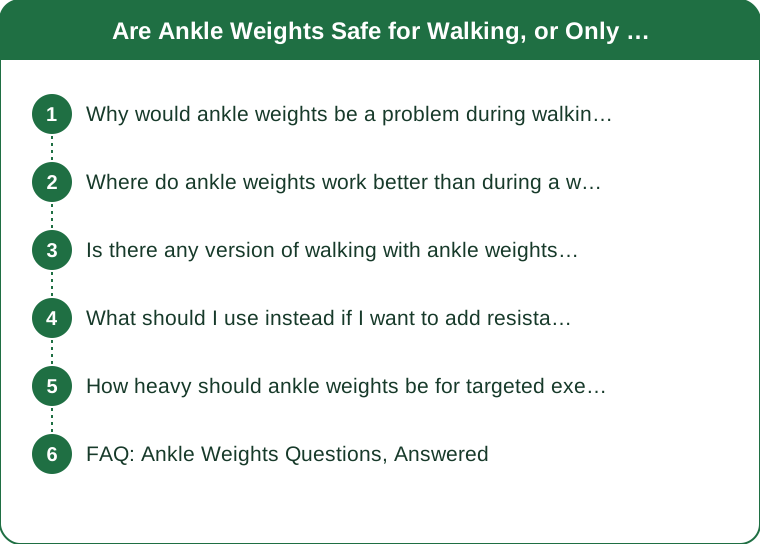
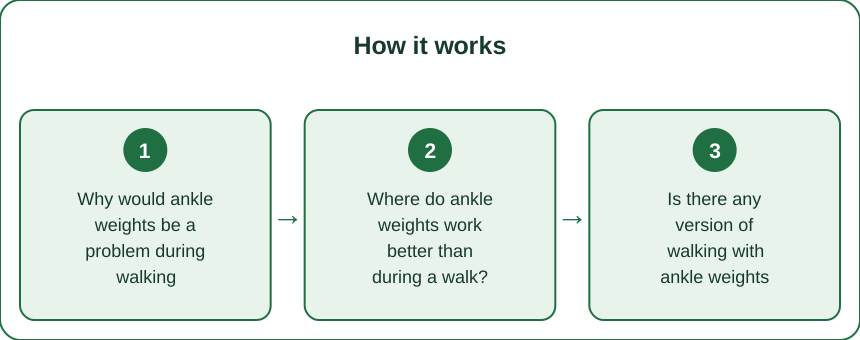
Why would ankle weights be a problem during walking specifically?
Walking is a repetitive, high-rep movement — thousands of steps per walk — and ankle weights add resistance at the farthest point from your hip, which increases joint torque with every single step, not just during a focused set.
Over a 30-45 minute walk, that repeated added torque is where the joint stress concern comes from, more than from any single stride.
Where do ankle weights work better than during a walk?
Targeted, lower-rep exercises — leg lifts, glute kickbacks, standing hip abductions — use ankle weights for a controlled number of reps, which limits the cumulative joint stress while still adding resistance.
This is the main reason most trainers separate ‘ankle weights for walking’ (generally discouraged for long duration) from ‘ankle weights for targeted exercises’ (generally fine).
Is there any version of walking with ankle weights that’s reasonable?
Short bursts — a few minutes at a time, not a full walk — with lighter weights (1-2 lbs) are a more moderate approach some trainers suggest, rather than wearing them for an entire walking route.
Even then, watching for knee or hip discomfort during the walk is important — discomfort is a signal to remove them, not push through.

What should I use instead if I want to add resistance to walking?
A weighted vest distributes added resistance through your core and spine rather than concentrating stress at the ankle joint, which is generally considered a safer way to add walking resistance.
Incline walking (treadmill or hills) is another alternative that increases effort without adding external weight at a joint at all.
How heavy should ankle weights be for targeted exercises?
Starting around 1-3 lbs per ankle is common for beginners, progressing gradually. Heavier weights (5+ lbs) are generally reserved for more advanced training and shorter exercise sets, not endurance activities.
FAQ: Ankle Weights Questions, Answered
Can ankle weights cause long-term joint damage?
Used appropriately for short, targeted exercises, the risk is low; used for long-duration high-rep activities like walking, some trainers and physical therapists flag increased joint stress risk over time.
Are ankle weights good for beginners?
Yes, for targeted strength exercises at light weight — they’re a reasonable beginner tool when used for their intended purpose rather than as a walking add-on.
Do ankle weights help with weight loss?
Any added resistance burns marginally more calories, but the effect is small compared to the potential joint stress trade-off during high-rep activities like walking.
TL;DR:
- Ankle weights add real joint torque with every step during walking, which compounds over thousands of steps
- They work better for short, targeted, lower-rep exercises like leg lifts
- A weighted vest or incline is a safer way to add resistance to walking specifically
- If using them for walking anyway, keep it brief and light, and stop at any joint discomfort
This is general information, not medical advice — check with a professional if you have existing joint concerns.
Keep Reading
This article is for general informational and styling purposes only. Fit, sizing, and product availability may vary.