1, 3, or 5 Pounds? Choosing Ankle Weights That Match the Job
Quick Answer: Buy by activity, not ambition: 1 to 2 pounds per ankle for walking and long mat sequences, 2 to 3 pounds for standard Pilates and barre-style leg work, 3 to 5 pounds for slow, targeted glute and hip strengthening - and zero pounds for running, ever. Because the weight sits at the end of a long lever, each pound at the ankle demands several times more muscle force than a pound held at your chest. An adjustable 1-to-5 pound pair covers every stage for most people.
The five-pound set feels like the serious choice at checkout. Then the hip flexors file a complaint by day three, the form dissolves, and the weights migrate to the closet - the standard life cycle of ankle weights bought by ambition instead of arithmetic.

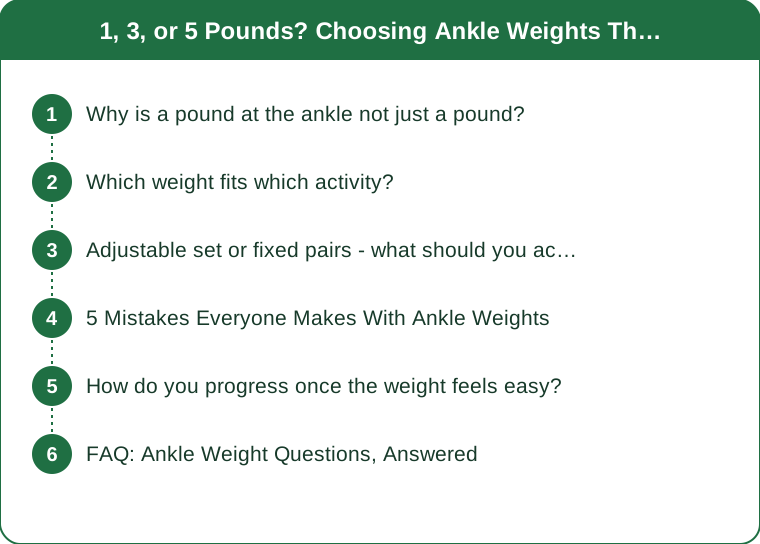
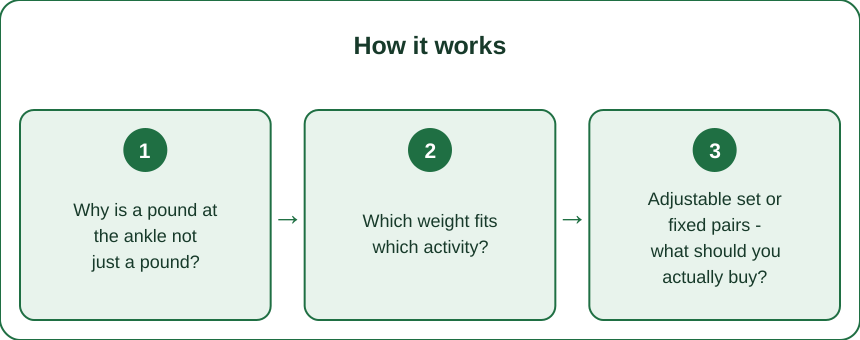
Why is a pound at the ankle not just a pound?
Because of leverage - the single fact that explains every recommendation in this article.
Your leg is a long lever pivoting at the hip or knee. The farther from the pivot a load sits, the more torque it demands from the muscles controlling it. A weight strapped at the ankle sits at the very end of that lever - roughly three feet from the hip - so the muscle force required to move it is several times what the same weight would demand held close to your body. Two pounds at the ankle during a straight-leg lift asks the hip muscles for effort in the neighborhood of what ten-plus pounds would ask for near your torso.
This is simultaneously the product’s magic and its trap:
- The magic: tiny, cheap, joint-friendly-looking weights create genuinely meaningful resistance for small stabilizing muscles - glute medius, deep hip rotators, inner thigh - that are hard to load any other way without machines.
- The trap: the same multiplication applies to every swing and every rep of momentum. Weight your ankles beyond what the target muscle can control and the body recruits helpers - hip flexors yank, the lower back arches, the movement gets faster and sloppier - and the exercise quietly changes owners.
So the right question was never how much can I strap on. It is how much can the small muscle I am targeting move slowly, with control, for every rep of the set. That number is smaller than retail ambition suggests - and it is different for every activity, which is the next section.
Which weight fits which activity?
The honest matching table:
Walking: 1 pound per ankle, maybe 2 - and consider skipping them entirely. Walking multiplies everything by thousands of steps, and even a pound noticeably alters gait mechanics at the hip and knee over a half-hour walk. If the goal is harder walks, incline, pace, or a weighted vest (which loads the torso, not the lever-end) are better tools. If you love the ankle-weight walk ritual, keep it to 1 pound, flat routes, 20 to 30 minutes.
Mat Pilates, barre-style series, and high-rep leg work: 2 to 3 pounds. The sweet spot for side-lying leg lifts, clamshell variations, and standing balance series - enough to make rep 12 honest, light enough that rep 12 looks like rep 2. Long sequences of 15-plus reps bias toward the 2; shorter, slower sets earn the 3.
Targeted glute and hip strength work: 3 to 5 pounds. Slow donkey kicks, fire hydrants, standing abductions, tabletop series - performed deliberately, 8 to 15 reps, these muscles can handle and benefit from the top of the home range. This is where 5 pounds belongs, and roughly the only place.
Arm work in dance-cardio formats: 0.5 to 1 pound wrist weights - a different product for a different lever.
Running, jumping, sports, all-day wear: zero. Impact multiplies the lever math catastrophically at joints and tendons, and all-day wear delivers thousands of micro-reps of altered mechanics with no recovery. Both are how ankle weights earned their bad reputation - neither is how they are meant to be used.
Adjustable set or fixed pairs - what should you actually buy?
For most people: one adjustable pair covering 1 to 5 pounds per ankle beats owning fixed pairs, for three practical reasons.
Progression is the entire point. Muscles adapt; the correct weight in March is warm-up weight by June. Adjustable cuffs - the kind with removable sandbag inserts or add-on pods - let you climb in half-pound or one-pound steps without repurchasing. Fixed pairs freeze you at a snapshot of your March strength.
Different exercises want different loads on the same day. A session might sensibly run 4 pounds for slow glute kicks and strip down to 2 for the long abduction series. One adjustable pair does this in thirty seconds; a drawer of fixed pairs does it with clutter.
Cost and storage both favor it. One decent adjustable set typically undercuts two or three fixed pairs and lives in one spot.
What to check on any cuff, adjustable or not:
- A wide, rigid-backed strap with serious velcro. A loose cuff rotating around your ankle mid-set changes the load line and chafes; the strap should lock the weight still through a full set of kicks.
- Soft, sweat-tolerant lining - these sit against bare skin or thin leggings and will get sweaty.
- A snug taper that clears your sneaker collar and does not stack on the ankle bone itself.
Fixed pairs earn their place in two cases: studio formats where fast on-off matters more than range, and as a dedicated 1-pound walking pair if that ritual is yours. Otherwise, buy the range, not the number.

5 Mistakes Everyone Makes With Ankle Weights
Mistake 1: Buying the 5s on day one. The most common purchase and the most common abandonment. Leverage math means 5 pounds at the ankle is an advanced load for the small muscles it targets - start at 2, master slow control, and let boredom, not ambition, trigger the upgrade.
Mistake 2: Wearing them all day for passive toning. Thousands of low-grade altered-mechanics reps at the hip and knee, zero strength stimulus in return - the target muscles need challenging sets, not ambient drag. If it does not feel like exercise, it is not building anything; it is just rehearsing a limp.
Mistake 3: Running or doing cardio jumps in them. Impact plus end-of-lever load is the recipe for cranky knees, shins, and hip flexors. Weighted cardio wants a vest; ankles want controlled tempo work.
Mistake 4: Letting momentum do the reps. The swing is the tell - when a leg lift turns into a leg toss, the target muscle handed the job to momentum and the hip flexors. The fix is free: slow every rep to two counts up, two counts down. If that tempo is impossible at your current weight, the weight is wrong, and mistake 1 has been re-committed.
Mistake 5: Ignoring the lower back’s opinion. Arching and wobbling during kickbacks means the load outran your trunk control. Drop a pound, shorten the range, or brace deliberately - a glute exercise that your lower back performs is a bad trade. Anyone with existing hip, knee, or back issues should clear loaded leg-lift work with a professional first; this is general information, not medical advice.
How do you progress once the weight feels easy?
In this order - and weight is deliberately last:
1. Slow down first. Take the same weight from a 1-1 tempo to 2 counts up, 1-second hold, 3 counts down. This alone can add weeks of productive challenge to a 2-pound cuff and builds exactly the control that protects the upgrade later.
2. Add reps and rounds next. 10 reps to 15, two rounds to three, before anything else changes. Endurance in these small muscles is most of what daily life and long workouts actually ask of them.
3. Then shrink the leverage help. Straighten the working leg (a bent-knee lift is a shorter lever - extending it is a free upgrade), reduce hand support on balance work, slow the lowering phase further.
4. Only then add a pound. One pound per ankle at a time, and expect to re-earn your rep counts at the new load. The climb from 2 to 5 pounds done this way typically spans months - which is the correct speed for tissue that includes tendons, not just muscle.
A weekly shape that works: two or three sessions of 15 to 20 minutes of weighted leg work on non-consecutive days, layered into or after your usual training. Small muscles recover fast but still deserve a day between targeted sessions.
And keep the win criteria honest: the mirror-visible outcomes people buy ankle weights for - steadier balance, stronger-feeling hips, better squat control, shape changes - come from months of progressive sets at controllable loads. The number on the cuff was never the achievement. The tempo was.
FAQ: Ankle Weight Questions, Answered
Can ankle weights help tone my legs while I walk?
Modestly at best, and at the cost of altered gait mechanics over thousands of steps. For visible leg and glute change, ten minutes of slow, targeted weighted floor work beats an hour of weighted walking - the walk is cardio, and it does that job better unweighted.
Are 1-pound ankle weights even worth it?
Genuinely yes, in the right slots: long high-rep sequences, dance-cardio formats, walking if you insist, and as the entry load for anyone returning from injury or starting from deconditioning. Leverage means 1 pound at the ankle is never actually 1 pound of demand.
How do I know the weight is right for an exercise?
The last-three-reps test: the final reps of your set should feel challenging while looking identical to the first three - same speed, same range, no swing, no back arch. Easy throughout means go up a step; form decay before the set ends means go down.
Ankle weights or resistance bands for glute work?
Both work; they load differently. Bands add resistance that peaks at the top of the movement and demand constant outward tension; ankle weights load evenly through the arc, including the lowering phase, which bands barely resist. The strongest home setups use both - and the adjustable cuff plus a loop band covers nearly every lower-body exercise that exists.
TL;DR:
- Leverage multiplies every pound at the ankle - buy by activity: 1 to 2 pounds for walking and long sequences, 2 to 3 for Pilates-style work, 3 to 5 for slow glute strengthening
- Never run, jump, or wear them all day; that is how ankle weights earned their bad reputation
- One adjustable 1-to-5 pound pair with a wide locking strap beats a drawer of fixed weights
- Progress tempo, then reps, then leverage, then weight - one pound at a time over months
- The last-three-reps test decides the right load: challenging, but identical in form to the first three
Ankle weights are a leverage instrument disguised as a beginner toy, which is why the small numbers work and the impressive ones backfire. Buy the adjustable pair, start two pounds lighter than pride suggests, and let the tempo - not the label - be the thing that gets harder.
Keep Reading
This article is for general informational and styling purposes only. Fit, sizing, and product availability may vary.