What Ankle Weights Actually Do to Your Walk (and Why It Matters)
Quick Answer: Ankle weights add load at the end of a long lever, so they increase the effort of swinging the leg forward and alter stride mechanics - typically producing a slightly slower cadence, a longer ground contact time, and increased demand on the hip flexors and the muscles that control the knee. For short, deliberate sessions in a fit person, that is a training stimulus. For long daily walks, it is repeated loading of an altered pattern, which is where overuse problems come from. If you use them for walking, keep the load light, the duration short, and watch for pain rather than assuming adaptation.
They are cheap, they feel like an obvious upgrade, and they promise something for nothing on a walk you were doing anyway. The mechanics are more interesting than the marketing.

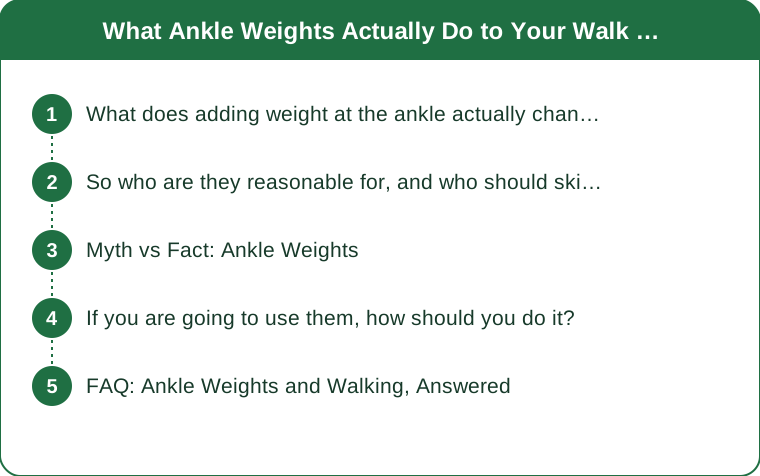
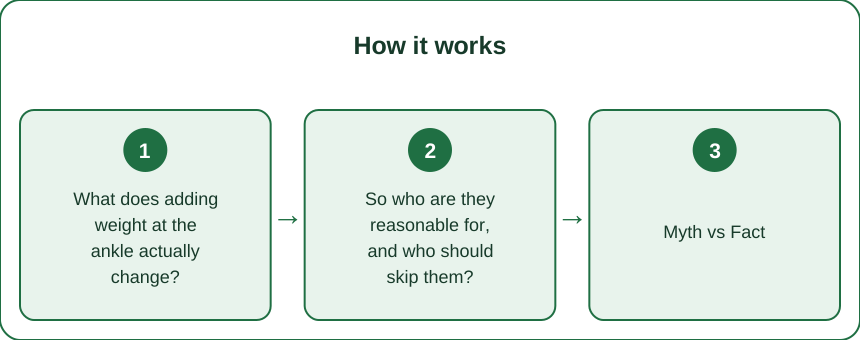
What does adding weight at the ankle actually change?
It dramatically increases the rotational demand of the swing phase. Rotational inertia scales with the square of the distance from the joint, so weight at the ankle is far more demanding to swing than the same weight worn at the waist. This is why a two-pound ankle weight feels disproportionate to its size - the effort is not about the two pounds, it is about where they are.
The hip flexors take most of the additional load. Swinging the leg forward is largely a hip flexor action, and they are working against a longer effective lever with every step. Over thousands of steps that is a substantial accumulation, and hip flexor tightness after weighted walking is the most commonly reported effect.
Stride mechanics shift measurably. Research on weighted-limb walking generally finds changes including reduced cadence, altered swing time, and increased energy cost. In plain terms: you walk a little differently, not just a little harder.
The knee sees a changed load pattern too. The quadriceps control the deceleration of the lower leg before heel strike, and a heavier lower leg means more work to decelerate. Some people notice this first as fatigue around the front of the knee.
And the energy cost does increase. Adding load raises the metabolic cost of walking, which is the entire premise. The question is not whether it works but whether the mechanical trade is worth the modest metabolic gain, and that depends heavily on how you use them.
So who are they reasonable for, and who should skip them?
Reasonable: short, deliberate strength sessions. Ankle weights used for standing leg lifts, side-lying abduction, glute work, or a specific 10 to 15 minute circuit are being used as what they are - a light resistance tool. This is the application with the clearest benefit and the lowest risk.
Reasonable: brief walking intervals for a fit walker. Ten to fifteen minutes of a longer walk, with light weights of one to two pounds, in someone with no lower-limb pain history and a well-established walking habit.
Questionable: long daily walks. An hour of altered mechanics, repeated daily, is a large volume of a modified pattern. This is the usage most associated with hip flexor irritation, knee discomfort, and shin pain, and it is also the most common way people use them.
Skip them: if you have any current lower-limb or back pain. Ankle weights amplify whatever pattern you already have. They are not a rehabilitation tool for an irritated joint, and adding load to a limp does not correct the limp.
Skip them: for balance work in older adults without supervision. Altered leg swing mechanics can affect balance recovery, which is exactly the wrong trade if fall risk is a concern. Strength training for the same population is well supported - it just should not be done by strapping weights to a limb during walking.
And skip them if you are pregnant or recently postpartum without guidance, since ligament laxity and altered pelvic mechanics are already changing gait considerably.
This is general information, not medical advice. Check with a clinician or physical therapist if you have joint pain, a history of injury, or balance concerns.

Myth vs Fact: Ankle Weights
Myth: Ankle weights are a free calorie boost on a walk you were doing anyway. Fact: They do raise energy cost, but modestly, and they alter mechanics at the same time. Walking 10 minutes longer, or adding a hill, raises energy cost without changing how you move.
Myth: Heavier is better. Fact: Beyond a light load - commonly one to three pounds - the gait alteration grows faster than the training benefit. Heavy ankle weights during walking produce large mechanical changes for a small metabolic return.
Myth: They tone your legs. Fact: Spot toning is not how muscle works. Light repetitive load builds some endurance in the involved muscles, but the visible change people are after comes from progressive resistance training and overall body composition.
Myth: If it does not hurt, it is fine. Fact: Overuse injuries develop from accumulated load over weeks, and by the time pain arrives the accumulation has already happened. Building up gradually matters more here than the absence of immediate symptoms.
Myth: A weighted vest and ankle weights are equivalent. Fact: A vest loads the trunk near the center of mass and barely changes gait mechanics, which is why it is the better tool for adding walking load. Ankle weights load the end of a lever and change the swing.
Myth: They help you walk faster. Fact: Cadence typically decreases with ankle load. If speed is the goal, they work against it directly.
If you are going to use them, how should you do it?
Start at one pound and stay there for at least two weeks. The rotational effect means even a small load is a real change, and starting at three or five pounds is how people end up with hip flexor pain in week one.
Cap walking use at 10 to 15 minutes initially. Add them for a segment of a walk rather than the whole thing, and take them off for the rest. This gives you the stimulus without an hour of altered mechanics.
Prefer them for stationary strength work. Standing hip abduction, glute kickbacks, side-lying lifts, and seated knee extensions all get real value from a one to three pound ankle weight with none of the gait concerns. If the goal is stronger hips, this is the better application by a clear margin.
Check fit before you check load. They should sit snugly just above the ankle bone without sliding, and without restricting circulation. Sliding weights cause chafing and change the effective lever length mid-walk.
Stop for numbness, tingling, or any sharp pain. Numbness or tingling in the foot is a signal to remove them immediately - it typically means the strap is too tight rather than that the load is too heavy, but either way it is not something to walk through.
And consider whether a weighted vest fits your goal better. If you simply want to add load to walking, a vest does that with far less mechanical disruption. Ankle weights are a targeted tool, not a general-purpose way to make walking harder.
This is general information, not medical advice.
FAQ: Ankle Weights and Walking, Answered
Are ankle weights bad for walking?
Not inherently, but they change gait mechanics - reducing cadence, lengthening ground contact, and loading the hip flexors and knee more. Short, light, deliberate use is reasonable; long daily walks in ankle weights are where overuse problems tend to appear.
How heavy should ankle weights be for walking?
Start at one pound and keep the total light, commonly one to three pounds. Beyond that the mechanical alteration grows faster than any training benefit, and heavier loads are more associated with hip flexor and knee irritation.
Do ankle weights help you lose weight?
They raise the energy cost of walking modestly, but walking longer or adding hills achieves the same thing without altering how you move. For body composition, progressive resistance training and overall energy balance matter far more.
Is a weighted vest better than ankle weights?
For adding load to walking, yes. A vest sits near your center of mass and barely changes gait, while ankle weights load the end of a swinging lever and measurably change stride mechanics.
What are ankle weights actually good for?
Stationary strength work - standing hip abduction, glute kickbacks, side-lying leg lifts, and seated knee extensions. That is where a one to three pound ankle weight delivers a real training effect with none of the gait concerns.
TL;DR:
- Weight at the ankle sits at the end of a long lever, so its rotational demand is far greater than its two pounds suggest.
- Expect measurable gait changes: slower cadence, longer ground contact, and much more hip flexor and quadriceps work.
- Short, light, deliberate use is reasonable; hour-long daily walks in ankle weights are the pattern most associated with overuse pain.
- Their best application is stationary strength work - abduction, kickbacks, side-lying lifts - not general walking load.
- If you just want harder walking, a weighted vest adds load near your center of mass without changing your stride.
- Stop for numbness, tingling, or sharp pain, and check with a clinician if you have joint or balance concerns. This is general information, not medical advice.
They are a targeted tool that got marketed as a general one. Used for 15 minutes of hip work, they are genuinely useful. Strapped on for an hour of daily walking, they are mostly a way to practice a different walk.
Keep Reading
This article is for general informational and styling purposes only. Fit, sizing, and product availability may vary.