How Heavy Should Ankle Weights Actually Be? A Straight Answer
Quick Answer: For floor-based strength work like glute and hip exercises, 1-2.5kg per ankle is the useful range for most people. For walking, the answer is usually zero - added weight at the ankle changes your gait and loads the knee in ways that outweigh the modest metabolic benefit. Adjustable weights that start at 0.5kg increments are the most useful purchase because the right load differs by exercise.
The question gets answered badly because it gets answered as one question. It’s really two, with two different answers.

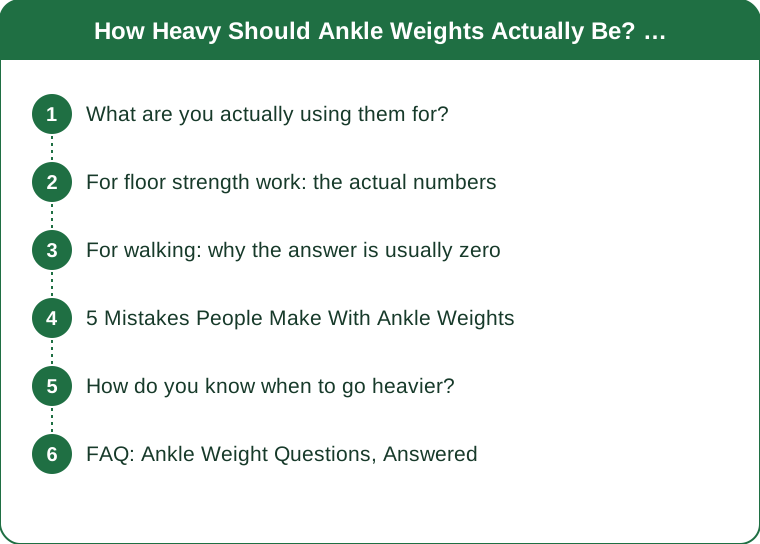
What are you actually using them for?
The right weight is entirely determined by the answer, and the two use cases pull in opposite directions.
Use case 1: floor-based strength work. Side-lying leg raises, glute bridges with a leg extension, donkey kicks, clamshells, fire hydrants. Here the ankle weight is functioning as external resistance for small muscles working through a range of motion - and it works well, because a long lever arm from hip to ankle means a small weight creates meaningful torque.
Use case 2: added load during walking or cardio. Here the ankle weight is functioning as a metabolic multiplier, and it’s a poor one. The added load sits at the end of a swinging limb, which alters gait mechanics rather than simply making the same movement harder.
Nearly all confusion about ankle weight selection comes from applying advice for one to the other. A weight that’s appropriate for a side-lying leg raise is meaningfully heavy on a 45-minute walk.
For floor strength work: the actual numbers
Start lighter than you expect and progress by feel.
Beginner: 0.5-1kg per ankle. This feels trivially light held in your hand and is not trivially light at the end of an extended leg through 15 reps. The lever arm does the work.
Intermediate: 1-2kg per ankle for most hip and glute exercises.
Advanced: 2-2.5kg per ankle, though at this point resistance bands or cable work usually offer better progression.
The selection test: the weight is correct if the last two or three reps of a set of 12-15 are genuinely difficult while your form stays clean. If you can do 25 reps easily, it’s too light. If your hips rotate or your lower back arches to complete a rep, it’s too heavy.
Progress by reps first, then weight. Move from 12 to 15 to 20 reps at a given load before adding 0.5kg. This is gentler on the joint structures involved than jumping weight early, and these are endurance-biased muscles that respond well to higher rep ranges.
For walking: why the answer is usually zero
This is the use case people ask about most and the one with the least support.
Ankle weights alter your gait. Load at the end of the swinging leg increases the effort of the swing phase and changes the timing of your stride. Your body adapts by subtly modifying how you walk, which is not a change you’re choosing or controlling.
The load path goes through the knee. Torque applied at the ankle during the swing phase is resisted at the knee and hip. Repeated over thousands of steps, this is a substantial cumulative exposure to a joint that wasn’t asking for it.
The metabolic return is modest. Added weight increases energy cost somewhat, but the same benefit is available with far less mechanical risk by walking faster, walking uphill, or carrying weight closer to your centre of mass in a weighted vest or backpack.
If you want to add load to walking, use a weighted vest or a loaded pack. Load near the torso doesn’t change limb mechanics and distributes through the whole kinetic chain rather than concentrating at one joint.
And if you do use ankle weights for walking anyway - some people will - keep them very light, under 1kg per ankle, cap the duration, and stop entirely at any knee or hip discomfort.

5 Mistakes People Make With Ankle Weights
1. Buying a fixed-weight pair. One weight is right for one exercise and wrong for the others. Adjustable weights with removable 0.25-0.5kg inserts are considerably more useful and usually cost little more.
2. Wearing them all day. The idea that all-day ankle weights build strength through incidental movement doesn’t hold up, and the cumulative joint exposure is real. They’re for specific exercise sessions.
3. Fastening them too loosely. A weight that shifts during movement changes the load unpredictably and chafes. It should be snug against the lower leg with no sliding, and positioned just above the ankle bone rather than over the joint itself.
4. Using them for running. This combines the gait alteration of walking with substantially higher impact forces. It’s the one application worth avoiding outright.
5. Ignoring numbness or tingling. Straps fastened tightly over the front of the ankle can compress a superficial nerve. Numbness or tingling in the top of the foot means loosen or reposition immediately, not push through. This is general information, not medical advice - persistent symptoms need a professional opinion.
How do you know when to go heavier?
Three signals, and all three should be present before you add load.
You can complete your target reps with two or three left in reserve. If a set of 15 finishes with the sense that you could have done 18-20 cleanly, you’ve outgrown the weight.
Your form holds through the entire set. No hip rotation on side-lying raises, no lower back arching on prone work, no momentum swinging the leg. Adding weight to a movement that’s already compensating just entrenches the compensation.
You’ve held the current load for at least two weeks. These are small muscles and connective tissue structures around joints with limited tolerance for rapid load increases. Two weeks at a given weight before progressing is a conservative and sensible pace.
When you do add, add 0.5kg or less. A jump from 1kg to 2kg is a 100% increase, which is enormous. This is exactly why adjustable weights with small increments are worth the extra few pounds at purchase.
And know when to graduate. Once you’re working at 2.5kg per ankle comfortably, resistance bands, cable machines, and loaded hip thrusts offer better progression paths than heavier ankle weights do.
FAQ: Ankle Weight Questions, Answered
Are ankle weights bad for your knees?
Used for controlled floor exercises at appropriate loads, they’re generally fine. Used for walking or running, the altered mechanics load the knee in ways worth avoiding.
Can I use them for physiotherapy exercises?
Often yes - many rehabilitation protocols use light ankle weights specifically. Follow the load your physiotherapist prescribed rather than a general guide.
What about wrist weights instead?
Same principles apply. Light loads for controlled exercises, not for walking or general wear.
How long do sessions with ankle weights need to be?
Ten to fifteen minutes of focused hip and glute work two or three times a week is a reasonable dose. These are supplementary exercises, not a full programme.
TL;DR:
- Floor strength work: 0.5-1kg to start, 1-2.5kg for most people, judged by the last two reps of a set of 12-15
- Walking: usually zero - use a weighted vest or pack instead, which doesn’t alter gait
- Buy adjustable weights with 0.5kg increments; one fixed weight is wrong for most exercises
- Progress reps before weight, and hold a load two weeks before adding
- Numbness or tingling in the foot means loosen or stop, immediately
The long lever from hip to ankle means small weights do real work. That’s also why heavy ones cause problems.
Keep Reading
This article is for general informational and styling purposes only. Fit, sizing, and product availability may vary.