How Heavy Should Ankle Weights Actually Be?
Quick Answer: For most people, useful ankle weights fall between 0.5 and 2kg per ankle, depending on the exercise. Anything heavy enough to visibly change how you move is too heavy - the point is added resistance to a good movement pattern, not a new movement pattern. Start at the low end, and use the form test rather than a percentage rule: if the last rep of a set looks different from the first, drop the weight.
The weight number matters far less than people think. What matters is the exercise you are using it for, and most of the harm comes from using them for the wrong thing entirely.

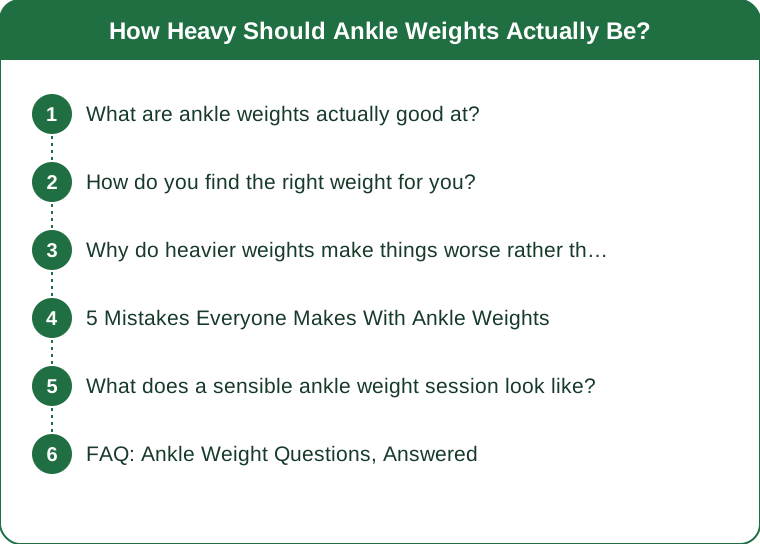
What are ankle weights actually good at?
A narrower list than the marketing suggests, and worth being clear about.
They work well for:
- Isolated hip work - side-lying leg raises, clamshells, standing abduction, fire hydrants. These are low-load exercises where a small external weight meaningfully increases the demand.
- Glute bridges with a leg extended, and similar floor-based single-leg movements
- Core work with the legs as the lever - leg lowers, dead bugs, hollow holds
- Rehab-style progressions where the jump from bodyweight to a machine or a dumbbell is too big
They work poorly for:
- Walking and running. The weight is at the end of a long lever moving fast, which changes gait mechanics and adds load to knees, hips, and the achilles in a pattern you did not train for.
- High-impact or plyometric work, for the same reason plus impact forces
- Anything where they change your form, which is the general rule underneath all of this
The core principle: ankle weights are a load tool for controlled, isolated movement. They are not a way to make general activity harder.
How do you find the right weight for you?
Use the exercise, not a formula. Three steps.
Step 1: Establish the bodyweight version. You should be able to do 15 to 20 clean repetitions of the exercise with no weight before adding any. If you cannot, the weight is not what is missing.
Step 2: Start at 0.5kg per ankle. This feels insultingly light and that is fine. On a side-lying leg raise, half a kilo at the end of a long lever is a substantial increase in torque at the hip - far more than the number suggests.
Step 3: Apply the last-rep test. Do a full set. If the final two repetitions look and feel like the first two - same range, same control, same speed, no compensating with the torso - the weight is appropriate. If the range shrinks, the tempo speeds up, or you start swinging, it is too heavy.
A rough progression: 0.5kg for isolated hip and core work as a beginner, 1kg once 20 clean reps is easy, 1.5 to 2kg for stronger lifters or for exercises with a shorter lever. Very few people benefit from more than 2kg per ankle in the exercises ankle weights are actually good for.
Buy adjustable ones. Fixed-weight pairs mean either buying multiple sets or being stuck at one load.
Why do heavier weights make things worse rather than harder?
Because the ankle is a long way from the joint doing the work, and load at distance changes movement.
When you lift a leg, the muscle at the hip has to overcome the weight of the leg times its distance from the hip. Adding a kilo at the ankle - the furthest possible point - has a large effect on that torque. Adding three kilos has a much larger one, and at some point the hip muscles cannot produce enough force through the full range.
What happens then is compensation. The torso leans, the lower back arches, the movement gets faster and uses momentum, or the range gets cut short. You are now training a different movement, usually one that loads the lower back more than the target muscle.
There is a second issue specific to walking. During gait, the leg swings forward quickly and then decelerates. Weight at the ankle increases both the effort to swing it and the force needed to stop it, and the decelerating is done by structures around the knee and hip. This is why ankle weights during walking are widely discouraged - the added load is going somewhere you did not intend and in a pattern your body did not adapt to.
If you want walking to be harder, walk uphill or carry weight on your torso, where the load sits close to your centre of mass.

5 Mistakes Everyone Makes With Ankle Weights
1. Wearing them for cardio. Walking, running, dance workouts, and step classes are all the wrong application. The lever length and the speed are what make them problematic, and neither is fixable with a lighter weight.
2. Wearing them all day around the house. The reasoning sounds appealing - constant low-level resistance - and the reality is thousands of repetitions of an altered gait. That is exactly how overuse problems develop.
3. Buying fixed-weight pairs. You outgrow 0.5kg within weeks on some exercises and never outgrow it on others. Adjustable sets solve this for roughly the same money.
4. Fastening them too loose. A weight that slides down toward the foot during a set changes the lever mid-exercise and rubs the skin raw. It should be snug above the ankle bone with no movement, and if it needs to be painfully tight to stay put, it is the wrong size for your leg.
5. Skipping the bodyweight version because weights feel more serious. This is the one that quietly limits results. If your unweighted side-lying leg raise has poor range and a rocking torso, the weighted version is just the same flawed pattern with more load on it. Earn the pattern first.
What does a sensible ankle weight session look like?
Short and specific. These are accessory tools, not a workout on their own.
A hip-focused block, 10 to 12 minutes:
- Side-lying leg raises: 3 sets of 12 to 15 per side
- Clamshells with the weight above the knee if it fits, otherwise at the ankle: 3 sets of 15 per side
- Standing hip abduction, holding a surface for balance: 3 sets of 12 per side
- Fire hydrants: 2 sets of 12 per side
Rest 45 to 60 seconds between sets. Two to three times a week, on days you are not doing heavy lower-body training, or immediately after it.
A core block, 8 minutes:
- Dead bugs, one leg at a time: 3 sets of 10 per side
- Leg lowers with the lower back kept flat: 3 sets of 8 to 10
- Single-leg glute bridges: 3 sets of 10 per side
Progression order matters: add repetitions first, then sets, then range, and only then weight. Jumping straight to a heavier weight is the most common way people stall or get sore.
Any sharp joint pain, numbness, or tingling means stop and reassess - and if it persists, see a professional. This is general information, not medical advice.
FAQ: Ankle Weight Questions, Answered
Are ankle weights bad for your knees?
Not inherently. Used for controlled, isolated exercises at appropriate loads they are fine for most people. Used during walking, running, or jumping, they add poorly-directed load to the knee and that is where the concerns come from.
Can I use them if I have had a knee or hip injury?
That is a question for the professional managing it. Ankle weights are commonly used in rehab settings precisely because they allow very small load increments, but the appropriate exercise and load are individual. This is general information, not medical advice.
Are wrist weights the same thing?
Similar principle, same caution about using them during cardio, and the same guidance about starting light. The lever is shorter so the effect per kilo is smaller, but the compensation risk during fast arm movement is comparable.
How long until I see results?
For strength and endurance in the target muscles, most people notice a difference in 4 to 6 weeks of consistent twice-weekly work. Ankle weights are a supplementary tool, so the results are proportionate to that role.
Should they be tight?
Snug enough not to slide during a set, sitting just above the ankle bone, with no numbness or tingling in the foot. If you need to overtighten to stop slipping, the strap length is wrong for you.
TL;DR:
- 0.5 to 2kg per ankle covers almost everyone; above that is rarely useful
- Use the last-rep test: if rep 12 looks different from rep 1, go lighter
- Good for isolated hip work, floor-based single-leg work, and core with the leg as a lever
- Bad for walking, running, jumping, and all-day wear - the lever and the speed are the problem
- Progress reps, then sets, then range, then weight - in that order
Ankle weights are one of the few pieces of equipment where the cheapest, lightest version does almost all of the useful work. Buy adjustable, start at half a kilo, and judge by whether your last repetition still looks like your first.
Keep Reading
This article is for general informational and styling purposes only. Fit, sizing, and product availability may vary.